
Connecticut Projected Release Dates
Connecticut does not publish one field that can always be read as the projected release date. The Connecticut Department of Correction, or CT DOC, identifies Maximum Release Date, Estimated Release Date, and Special Parole Date among its public information fields. Its FAQ also identifies Minimum Release Date. Each label answers a different sentence question. None proves that a person left a facility, entered the community, or completed all supervision.
Maximum Release Date concerns sentence computation. Estimated Release Date has a special historical meaning for certain older sentences. Special Parole Date concerns a court-imposed period that follows incarceration. A minimum date may help explain an eligibility point, yet eligibility is not the custody event. The record’s current location, status, sentence facts, and detainer field must be read with the date. A move to a halfway house or transitional supervision may be a release from a prison building while CT DOC still has authority over the person.
The CT DOC information-systems description shows the official date fields.
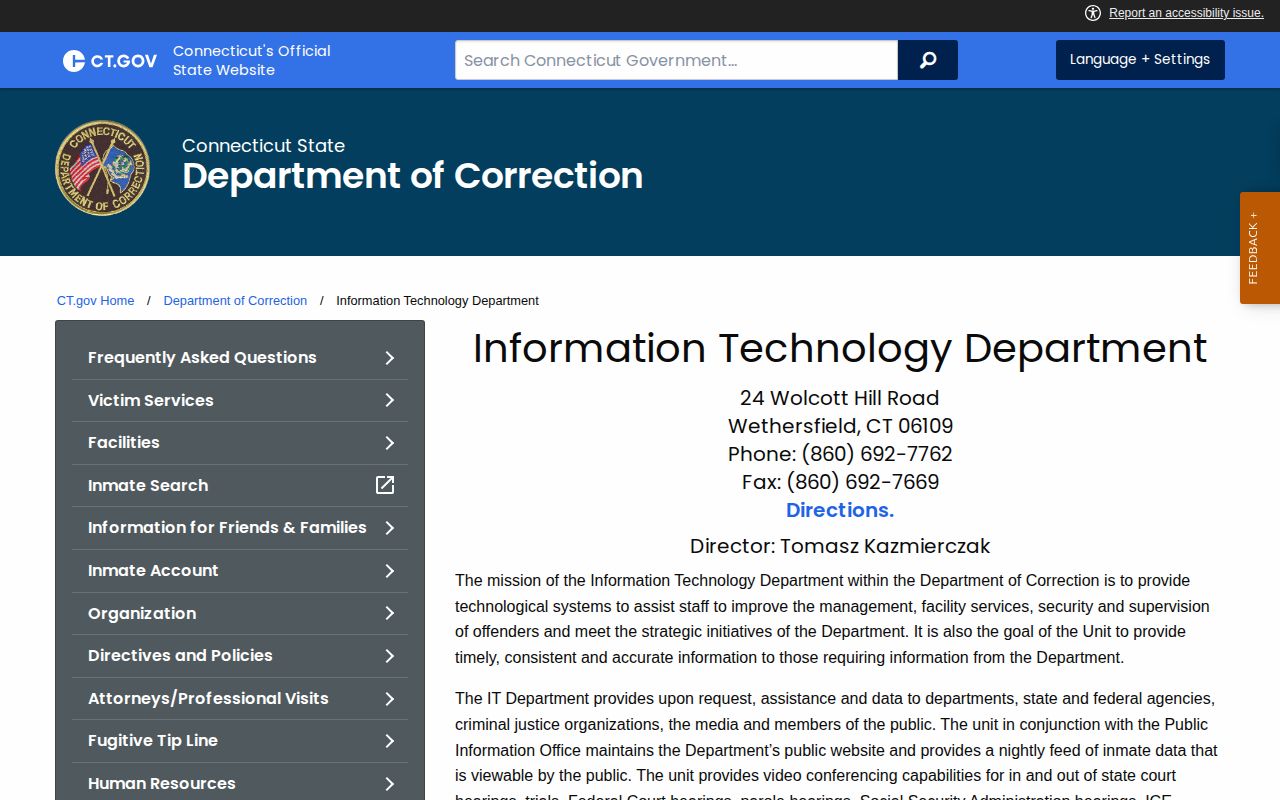
The source also says the public search receives a nightly OBIS feed, so a same-day change may not appear at once.
Find a Connecticut Release Date
Begin with the official CT DOC search when the person is or recently was under Connecticut correctional authority. A CT DOC number is the best key when it is known. Name and date of birth can be used when it is not. Compare all available identifiers before relying on a match, since a name alone can point to the wrong person. The live tool is framed as a current-custody search, not as a full archive of everyone discharged from CT DOC.
- Open the official CT DOC Inmate Information Search and enter the CT DOC number, or use name and date of birth.
- Open the matching record only after comparing the person’s identifiers.
- Read current location and status before reading any sentence date.
- Compare Maximum Release Date, Estimated Release Date, Special Parole Date, sentence date, and any detainer shown.
- Allow for the nightly update cycle and confirm a near-term event through CT DOC or an official record.
The CT DOC Inmate Information Search supplies the current lookup form.
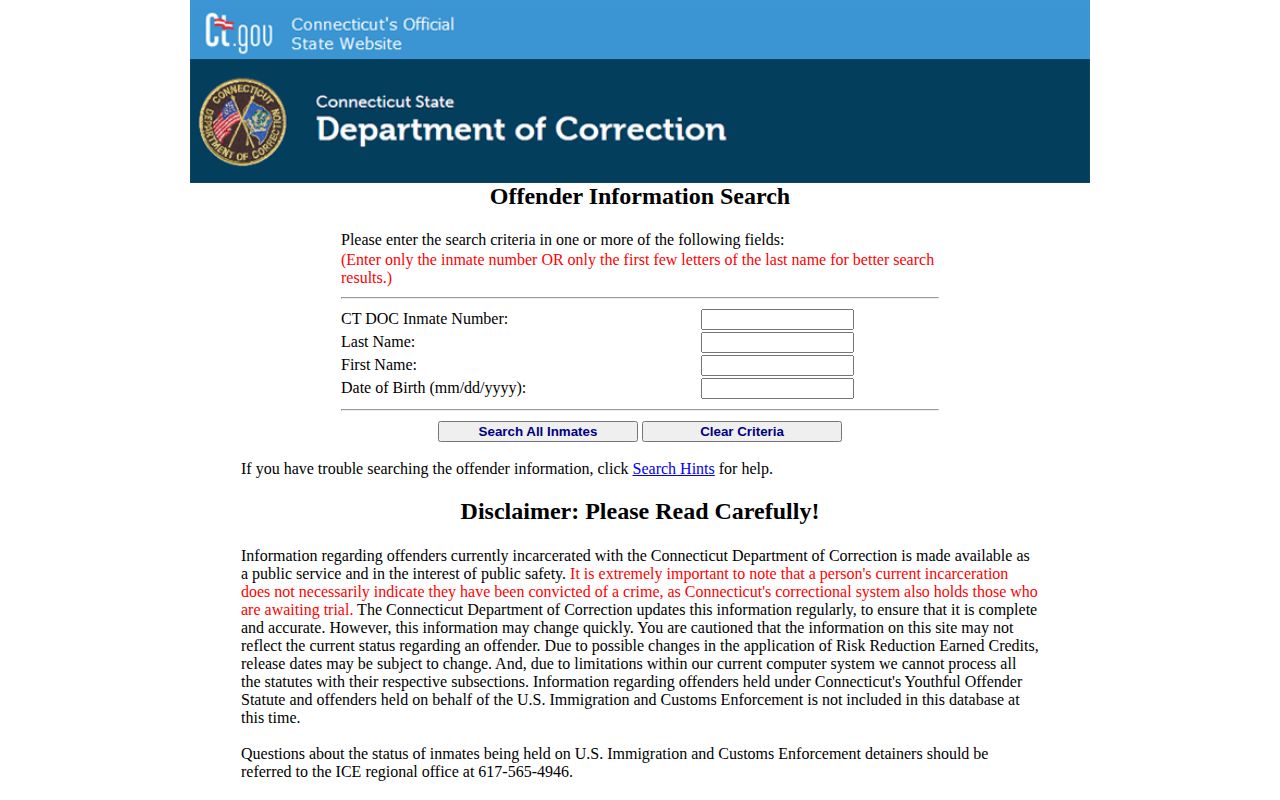
The form is a starting point for the calculation, but an absent result does not establish that release occurred.
For a deeper explanation of current-search and discharged-record routes, use the CT DOC offender search page. A person missing from the live system may be fully discharged, may never have entered CT DOC, may be in federal or immigration custody, or may have been searched with the wrong identifiers.
Note: A person held before trial usually has no sentence-based release date because court action, bond, and other holds control release.
Connecticut Release Date Labels
Read the precise label, not just the date. Connecticut’s terminology changes with the sentence era, and similar-looking fields can reflect different statutes. CT DOC Administrative Directive 4.2 defines Estimated Release Date, or ERD, for sentences imposed for offenses committed from July 1, 1983 through September 30, 1994. That estimate accounts for presentence credit, earned and lost good time, and statutory good time that could still be earned. The directive says ERD is not the actual discharge date.
| Connecticut field | How to read it |
|---|---|
| Maximum Release Date | A sentence-computation date used for later definite sentences, adjusted by credit actually awarded or forfeited where the law permits. |
| Estimated Release Date | A technical estimate tied to the 1983 to 1994 offense window under Directive 4.2, not proof of discharge. |
| Special Parole Date | A date tied to court-imposed special parole after incarceration, not the same as ordinary parole eligibility. |
| Minimum Release Date | A published information field that must be read with the sentence and governing release rule. |
| Projected Discharge Date | A classification term used for indeterminate or indefinite sentences, distinct from the other public labels. |
The CT DOC FAQ identifies the public sentence and release information.
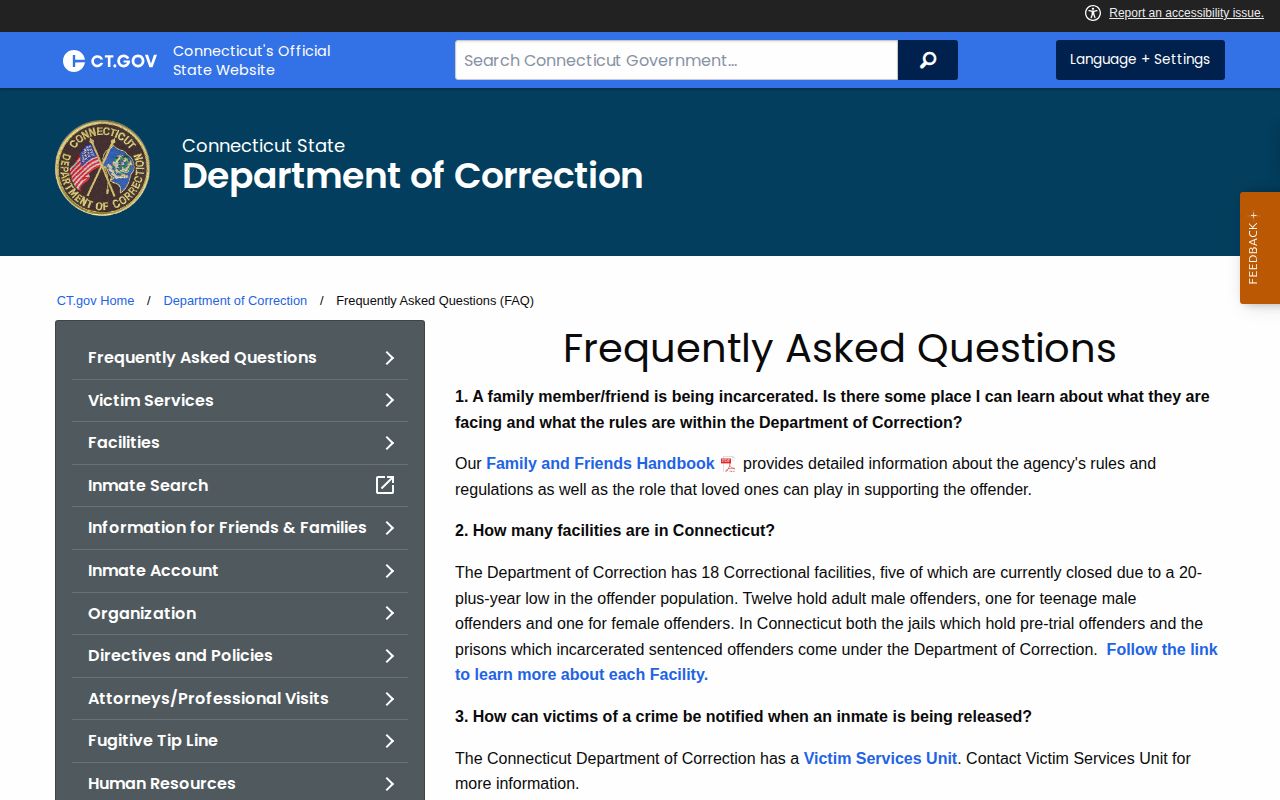
Its field list should be used with the more detailed sentence-era rules, not as a guarantee that each date means the same thing.
Connecticut Earned Release Credit
Connecticut General Statutes §18-98e governs Risk Reduction Earned Credit, often shortened to RREC. The commissioner may award an eligible committed person up to five days per month. Criteria include following an offender accountability plan, taking part in eligible programs and activities, obeying rules, and maintaining good conduct. The credit is discretionary. Good conduct by itself does not create a right to receive it.
Credit may be removed for misconduct, insubordination, refusal of recommended programming, refusal to follow rules, or other good cause. When the person does not have enough banked credit, a loss may be applied to future credit. The statute also excludes listed serious convictions and specified persistent-offender categories. Eligibility therefore depends on the controlling conviction and current law. A broad offense label is not enough to predict how many days will be awarded.
| Credit issue | Connecticut rule |
|---|---|
| Possible rate | Up to five days per month for an eligible person, at the commissioner’s discretion. |
| Core factors | Accountability-plan compliance, eligible activities, good conduct, and obedience to facility rules. |
| Loss | Awarded or future credit may be removed for stated misconduct or other good cause. |
| Exclusions | Enumerated serious convictions and specified persistent-offender categories are excluded. |
| Effect | Credit may change sentence computation, but it does not guarantee release on a displayed date. |
Older Connecticut sentences may involve statutory good time, enhanced statutory good time, presentence good time, meritorious awards, forfeiture, and restoration under Directive 4.2. A modern definite sentence should not be described as earning automatic traditional good time. The actual award and sentence era matter.
Note: Consult the current statute for the controlling conviction because the exclusion list and a person’s eligibility cannot be inferred from a nickname.
Connecticut’s Sentence-Era Release Rules
Connecticut’s projected-release language is unusually dependent on when the offense occurred. Directive 4.2 places ERD within the July 1983 to September 1994 offense window. The DOC classification manual uses maximum release date for later offenses and accounts for RREC actually awarded and any forfeiture. It uses projected discharge date for indeterminate or indefinite sentences. Those distinctions prevent a newer maximum date from being read as though it were an older ERD.
The difference also explains why a search result should be preserved with its label and the date it was viewed. Sentence computation can change as credits are posted or removed. Court corrections, additional sentences, and valid detainers can also alter what happens at the end of a Connecticut term. The source record is more useful when the reader can tell which calculation was displayed, rather than copying a bare date without context.
Presentence credit is another part of the record that can matter. It reflects qualifying time credited before the sentenced term is served in CT DOC, but it should not be guessed from an arrest date or a docket summary. Older statutory good-time systems also contain rules for credit, debit, forfeiture, and possible restoration. Their presence in Directive 4.2 does not mean every type applies to every sentence. The correct approach is to identify the offense date, sentence form, controlling judgment, and credit entries before interpreting the release calculation.
The Connecticut Department of Correction site provides the statewide correctional context.
Connecticut’s unified system means both former county-jail functions and state prison terms route through CT DOC, though brief police and court custody follow different records.
Parole Versus Connecticut Release Dates
Parole eligibility is not a projected release date. Under §54-125a, many people serving definite terms longer than two years may generally be considered after 50 percent of the controlling sentence, less applicable credit. Specified violent offenses use an 85 percent service threshold. Exclusions and special rules apply. Reaching the threshold lets the State of Connecticut Board of Pardons and Paroles consider the case. It does not require the Board to grant parole.
A grant still does not prove physical release. BOPP describes its date as an “on or after” date. Placement, an approved residence, sponsorship, transport, conditions, discipline, new charges, or rescission may affect the actual departure. Special parole differs again because a court imposes it to follow incarceration. Near-maximum parole and post-grant transfer have their own statutory terms, and a move into community placement can leave the person under state authority.
- Parole eligibility
- The point when BOPP may consider a qualifying case.
- On or after date
- The earliest Board-authorized date after a grant, subject to release planning and later events.
- Special parole
- A court-imposed supervision term that follows incarceration.
- Final discharge
- The end of the commissioner’s custody after court-imposed time is complete.
Why Connecticut Release Dates Change
A displayed sentence date may move for several lawful reasons. Some are part of sentence computation. Others control whether a person can leave on the expected day. Directive 9.3 shows how a court release order is checked against other valid sentences and detainers before staff treat the person as free to go. If another hold exists, the person returns to the facility instead of leaving custody.
| Factor | Possible effect |
|---|---|
| RREC award | Eligible credit actually awarded may reduce the sentence calculation. |
| Credit forfeiture | Misconduct or another statutory ground may remove credit and move the date later. |
| Court action | A corrected sentence, new order, or new case can change the controlling calculation. |
| Detainer or other sentence | Another authority or valid term may keep the person in custody after a Connecticut release step. |
| Parole decision | Eligibility, grant, denial, rescission, and placement affect timing but are not the same as actual release. |
| Nightly data cycle | A recent event may appear after the next OBIS update rather than at the moment it occurs. |
Note: A transfer between facilities changes location, not legal custody, and should never be reported as a release to the community.
Confirm a Connecticut Release
Use the current CT DOC record to check location, status, and sentence fields. Then verify the custody event rather than treating the forecast as final. CT VINE can supply forward-looking custody alerts, but it is not a permanent discharge archive. The statewide VINELink inmate search instructions explain Connecticut’s separate DOC and Judicial notification streams.
If the person no longer appears, Directive 4.4 supplies the historical path. Its section for people discharged from DOC says conviction information is released on request and other information may be available through a DOC Freedom of Information request. A focused request can identify the person, the relevant date range, and sentence-computation or discharge records sought. An absent current-search result alone is not proof of release.
Ask for existing records with enough detail to permit a reliable search. Useful identifiers include the full name, CT DOC number when known, and a limited date range. Describe the specific record, such as sentence-computation entries, incarceration and discharge history, or the recorded release mechanism. Connecticut’s FOI rules do not promise disclosure of medical, erased, youthful-offender, security-sensitive, or other exempt material. They also do not require an agency to create a new forecast that is not already maintained.
The Connecticut Judicial lookup hub provides the court-record route.
A court disposition can explain the sentence or probation outcome, but it is not a live custody roster and does not replace CT DOC confirmation.
Public Record Search
Sponsored Results