
CT DOC Release System
Connecticut’s correctional structure differs from the sheriff-run county systems common elsewhere. The state unified county jails and prisons under one department in 1968. Bridgeport, Hartford, New Haven, and Corrigan correctional centers perform principal jail and intake functions. Correctional institutions primarily hold sentenced people. This makes CT DOC the statewide correctional starting point for a person who left pretrial custody, moved between facilities, entered a community placement, went onto parole, or reached final discharge.
The legal status still controls the interpretation. A transfer to another CT DOC facility is not release. Placement in a halfway house or transitional program can mean physical departure from a prison while the commissioner retains authority. Parole and special parole involve community supervision. Full discharge is different: it ends the commissioner’s custody when the court-imposed time is complete.
The official CT DOC home page identifies the agency and its statewide operations.
The statewide agency structure is why a correctional-center record usually routes to CT DOC rather than to a county sheriff.
Use the CT DOC Offender Search
The CT DOC Inmate Information Search permits a search by CT DOC number, name, and date of birth. The number is the best starting key when known. For a name query, add the birth date and compare all available identifiers. A name by itself can point to the wrong person.
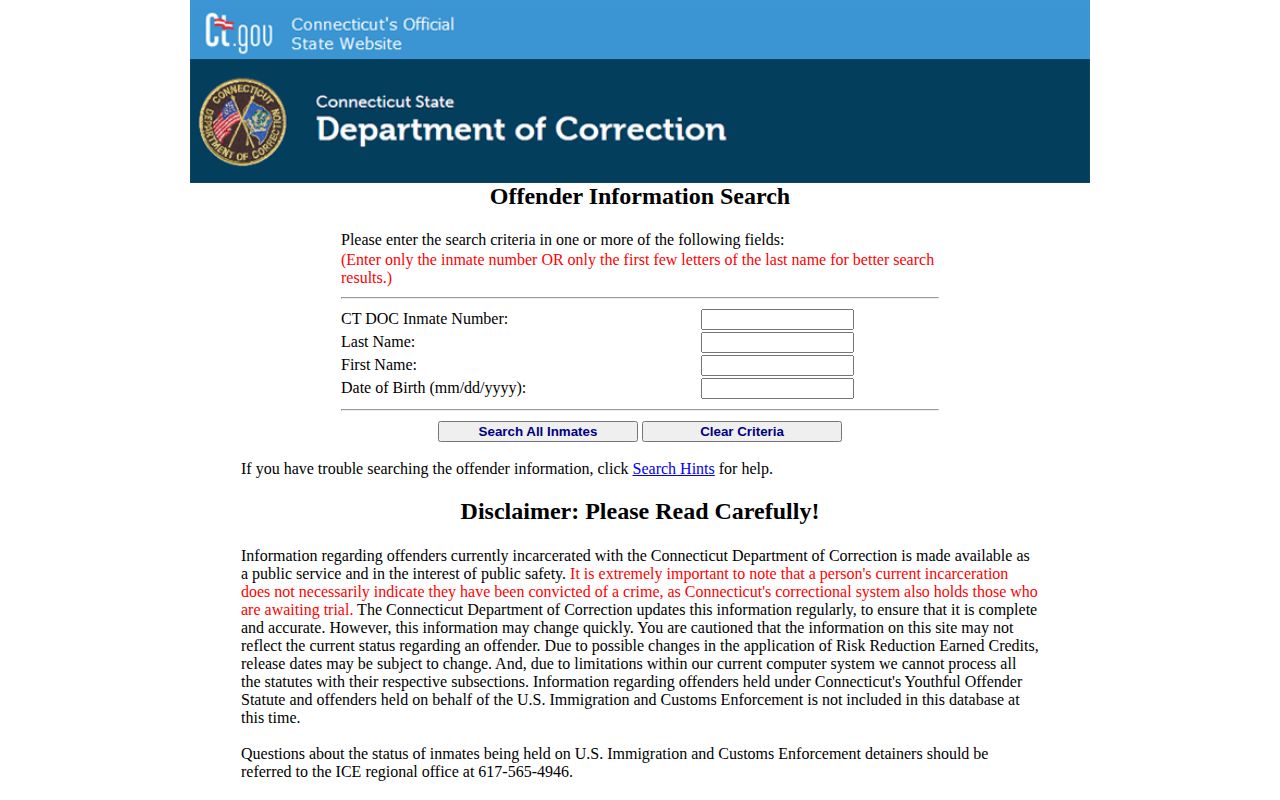
The form is the official current-status entry point, but its scope must be understood before treating a missing name as proof of release.
- Open the official search and enter the CT DOC number when available.
- Otherwise, enter the name and date of birth as accurately as possible.
- Open the matching record only after comparing official identifiers.
- Read current location and status before interpreting any release-related date.
- When the record is absent or cannot prove discharge, use the DOC records-request path.
DOC says its Offender Based Information System sends data to the public search nightly. It describes the covered population as people currently under DOC custody. A same-day court order, transfer, or facility event may therefore lag. The portal also warns that dates may change and that not all statutes are processed in the computer system.
Current-custody limit: No primary source confirms that every fully discharged person remains searchable or appears with an online “Released” or “Discharged” label.
CT DOC Offender Search Fields
The published CT DOC field inventory is useful even though no historical discharged-person result was confirmed. It includes identity, admission, custody, sentence, release-related date, and detainer information. Read those fields together. A date without the current location and status can be misunderstood, especially where a person has moved to a community program but remains under DOC authority.
| Field | How to read it |
|---|---|
| Inmate number | Unique CT DOC identifier for matching the correct person |
| Name and date of birth | Identity checks that reduce false matches |
| Latest admission date | Start point for the current or latest documented DOC episode |
| Current location | Facility, correctional center, or community-related placement |
| Status | Current operational category within the DOC system |
| Maximum release date | Sentence-computation field, not proof that release occurred |
| Estimated release date | A technical date whose meaning can depend on sentence era |
| Special parole date | Date associated with court-imposed supervision after incarceration |
| Detainer | Another authority’s hold that may affect departure or transfer |
The Management Information Systems Unit describes the nightly feed and official fields.
This system description supports current-custody use. It does not support inventing a historical release-date label for a fully discharged result.
The DOC FAQ additionally identifies minimum release date, correctional history, disciplinary history, and a photograph among information the agency may provide. Those items are not all guaranteed to appear in every public online detail.
Find Discharged CT DOC Offenders
Administrative Directive 4.4 provides the reliable route after full discharge. Section 6(A)(1) covers information about someone currently incarcerated or supervised. Section 6(A)(2), titled “For Offenders Discharged from DOC,” says conviction information shall be released on request and that other information about discharged people may be available through a DOC Freedom of Information request.
The distinction resolves two frequent mistakes. First, absence from the current search is not proof that release occurred. It can result from spelling, an identifier mismatch, a fully discharged record outside the current system, protected status, federal custody, ICE custody, or the fact that the person was never committed to DOC. Second, a person can be physically outside a prison and still appear because a community status remains under CT DOC authority.
A dependable workflow checks the current CT DOC offender search, then requests the discharged-person information if the portal cannot establish the event. The statewide criminal case disposition can explain the sentence or dismissal. Board of Pardons and Paroles minutes document a Board decision, while CT VINE supplies alerts. Neither is a substitute for the historical DOC discharge record.
Federal and immigration custody also explain some gaps. The BOP locator is the right system for federal inmates and can show a release date with “Released” or “Not in BOP Custody.” ICE operates a separate locator for current immigration detention, without a confirmed historical released-person archive. Neither database can be used to interpret a CT DOC sentence. When systems overlap, follow the identifiers, dates, and recorded detainer instead of relying on one missing name.
Note: Record a portal status only as displayed, and never convert a projected date, parole grant, transfer, or missing result into an actual discharge.
CT DOC Release and Discharge
Connecticut publishes releases in several legal and operational groups. Ordinary parole under §54-125a is discretionary release supervised in the community. Eligibility means the Board may consider release; it is not a release order. A granted case receives an “on or after” date, and placement, sponsor approval, transportation, conditions, discipline, new charges, or rescission can affect actual departure.
Special parole is imposed by the sentencing court and follows incarceration. Transitional supervision under §18-100d permits eligible people near the end of a sentence to serve the remainder in the community under DOC supervision. Halfway-house and transitional placements also remain community or field-service categories rather than final discharge. Near-maximum parole and post-grant transfer have separate statutory terms. End-of-sentence discharge alone ends the commissioner’s custody after completion of court-imposed time.
A court release order may still be blocked by another sentence or detainer. Directive 9.3 requires correctional staff to check with facility records when a judge orders release while a person is at court. A valid sentence or hold returns the person to the facility. Without one, the person may return voluntarily for discharge processing or may be released at court, depending on the circumstances. Thus, a court order and physical departure are related but not always identical events.
- Parole eligibility
- The point at which the Board may consider a case, not a promised exit date.
- Special parole
- Court-imposed supervision that follows incarceration.
- Transitional supervision
- Community service of the remaining sentence under DOC authority.
- End-of-sentence discharge
- Completion of the court-imposed time and the end of the commissioner’s custody.
CT DOC Gate Money Rules
Gate money does not accompany every CT DOC release. Administrative Directive 3.11 calls it discretionary assistance and an earned privilege. A person must have completed at least 24 continuous months of sentenced incarceration and must discharge directly to the community without supervision. That excludes releases to parole, halfway-house placement, and transitional supervision from the directive’s core eligibility condition.
The maximum is $50. A person whose relevant account savings reached at least $50 gets no payment; a person below that amount may get $50. The releasing facility normally supplies a check at discharge, it is not ordinarily mailed, and it can be received only once during a continuous incarceration term. Disciplinary and security concerns can also result in ineligibility. No universal bus ticket, clothing allotment, or transportation benefit was confirmed.
Directive 10.15 separately creates a pre-release process for identity documents, including birth certificates, Social Security cards, licenses, nondriver identification, state IDs, passports, military IDs, and permanent-resident cards. It establishes a process, not a guarantee that every discharged person receives every document.
CT DOC Release Trends
CT DOC statistics require both a date and a definition. March 2025 recorded 785 releases and discharges. The group included 413 end-of-sentence events, but it also included parole, special parole, halfway house, transitional supervision, furlough, transitional placement, home confinement, and transfer parole. The total was 7.4 percent below March 2024, when the comparable total was 848.
The FY2024–25 DOC digest used a different measure. It reported about 3,672 facility releases through Parole and Community Services, with about 2,005 placements into contracted halfway-house programs and 1,667 into approved community residences. On June 30, 2025, that division supervised 2,940 people across release statuses. These measures describe movement into programs and a supervised population. They are not a count of final discharges.
| Date | Measure | Correct reading |
|---|---|---|
| March 2025 | 785 releases/discharges | Mixed legal and community-status categories |
| FY2024–25 | About 3,672 facility releases | Moves to programs or approved residences |
| June 30, 2025 | 2,940 supervised | People across continuing release statuses |
| August 1, 2026 | 2,411 field services | A later monthly population under another reporting frame |
The CT DOC Monthly Statistics page hosts dated reports.
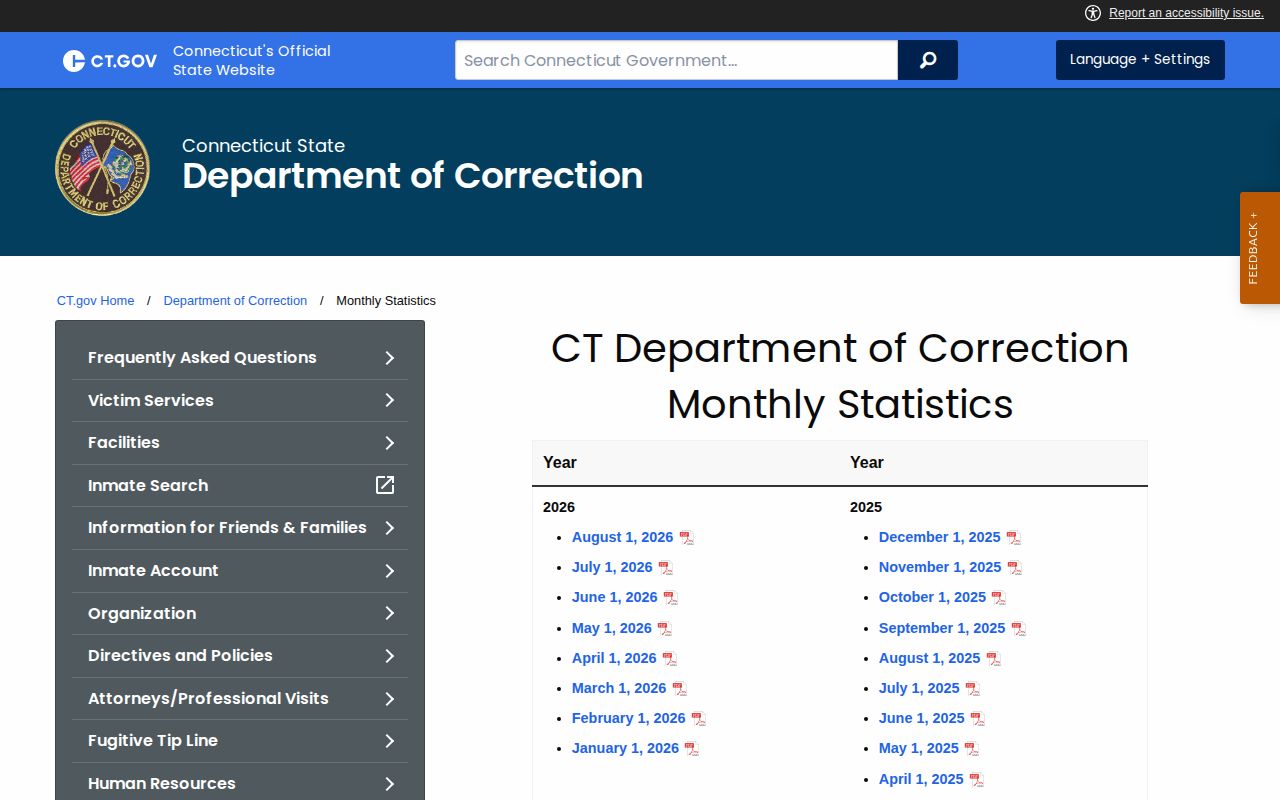
These reports can describe statewide movement and supervision, but only an individual record can establish one person’s status.
The historical supervised-population series gives added context without supplying an individual answer. It counted 17,805 people in total supervision in 2019, 12,750 in 2021, and 13,609 in 2024. Its July 1 snapshots combine incarcerated and community groups, while the August 2026 field-services table uses another reporting frame. The two series should not be joined as if they were the same measure.
OPM separately studied 4,633 sentenced people released or discharged during 2021. The cohort was nearly 60 percent smaller than the 2015 cohort, and half returned to DOC within three years for any reason. That finding describes a dated study group, not the current status, release route, or conduct of any named person.
CT DOC Release Locations
Correctional centers serve jail and intake roles, while institutions chiefly hold sentenced people. Releases can be processed at a facility or, under Directive 9.3, at court after correctional staff check for another valid sentence or detainer. A person may also move from a prison into a halfway house, transitional placement, approved residence, or other community status. Each move changes location, but not every move ends custody.
Statewide facility records help identify where an episode occurred. They do not replace the current CT DOC search, the court disposition, VINE alerts, Board minutes, or a DOC historical request. Closed facilities must also be separated from active operations; an old indexed agency page does not prove that a site still processes releases.
The full active and covered list is organized in the Connecticut Facility Directory. A municipal police cell or Judicial Marshal cell should be treated as brief holding connected to a police or court record, not as a separate historic county correctional system.
Request CT DOC Release Records
The CT DOC FOI Office coordinates public-record compliance and reports more than 3,000 documentation requests in an average year. Its published address is 24 Wolcott Hill Road, Wethersfield, CT 06109. The phone is 860-692-6290 and the fax is 860-692-7873. Requests may also be filed through the DOC GovQA portal.
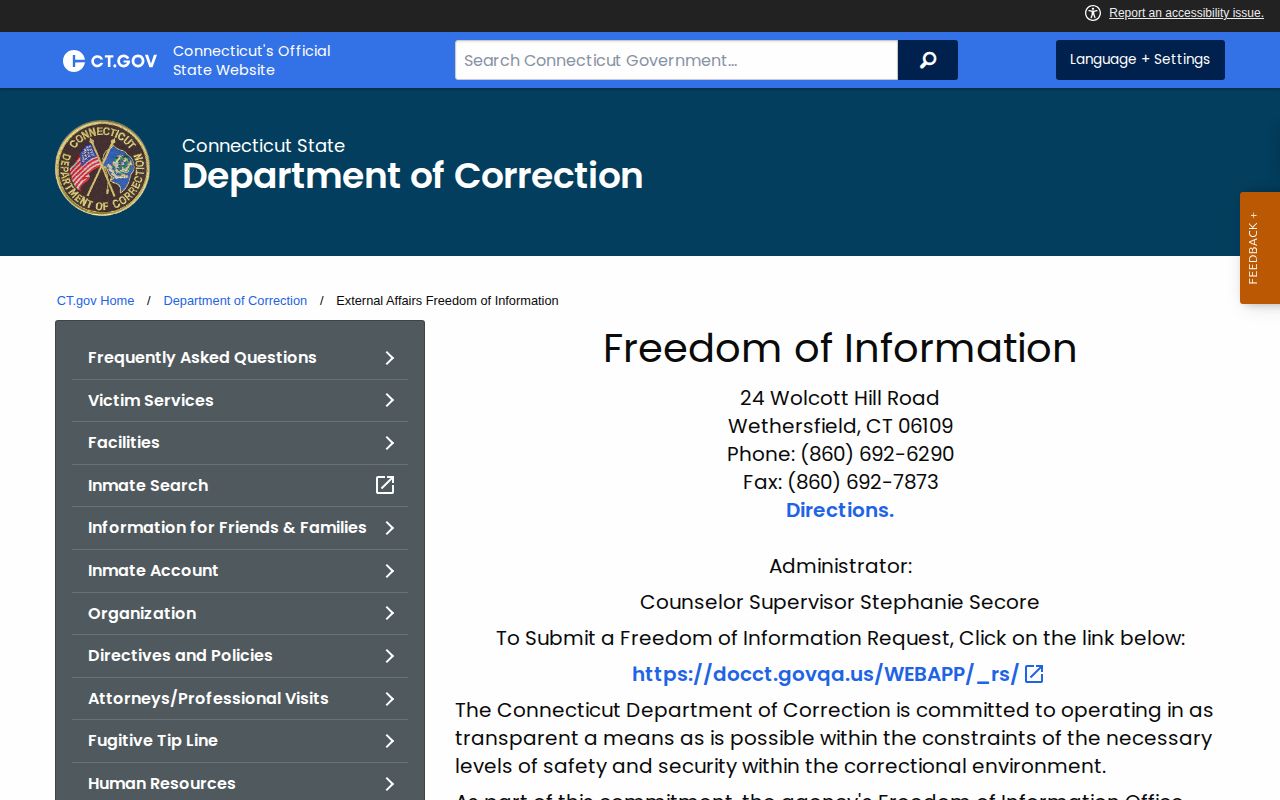
The office is the statewide routing point for DOC records, not an instruction to visit the facility from which a person left.
A clear request identifies the person by full name, CT DOC number when known, and enough added information to distinguish a match. Give a date range. Name existing records, such as admission and discharge history, sentence-computation records, the recorded release mechanism, or releasable conviction information. Directive 4.4 does not promise an entire master file.
The DOC FAQ helps frame which correctional details may be available.
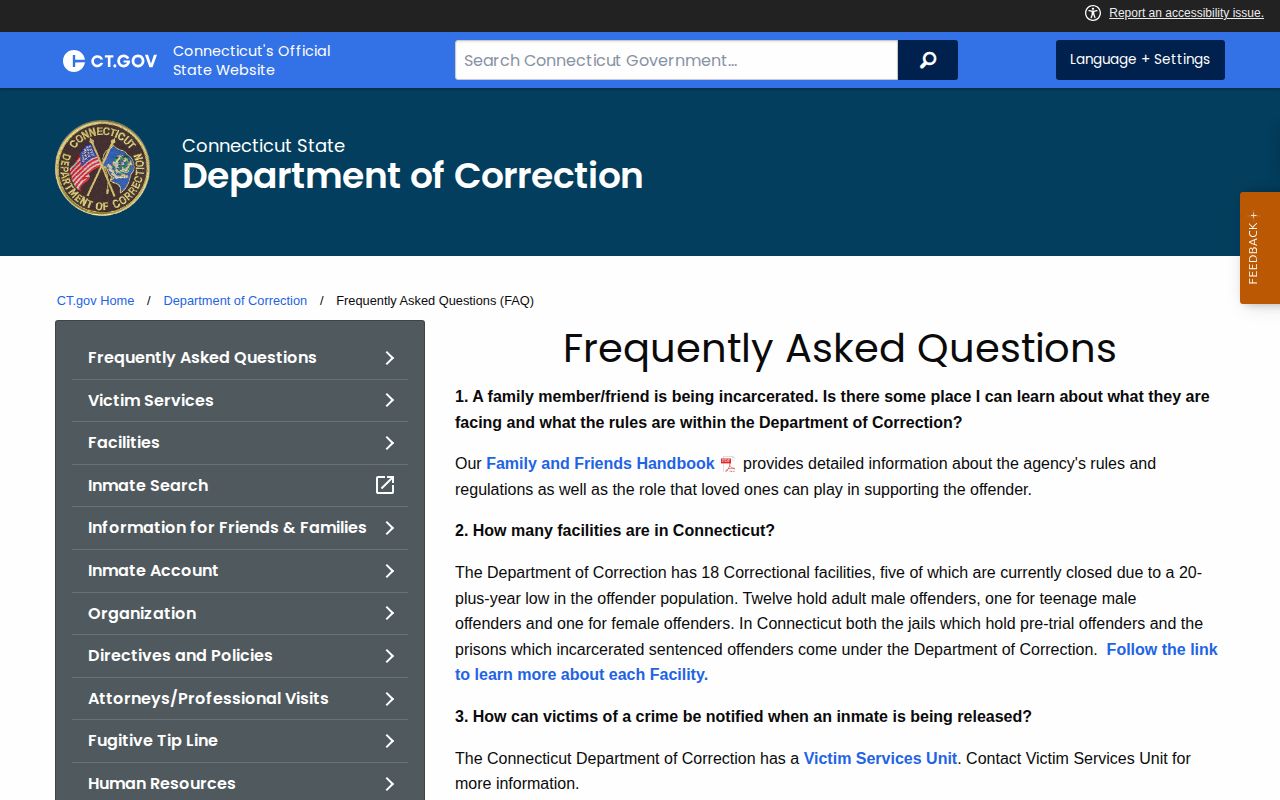
FOI exemptions, criminal-record erasure, youthful-offender rules, medical confidentiality, personal-data law, and institutional security may restrict the response.
Chapter 14 generally provides prompt inspection and copying of nonexempt public records. The FOI Commission says no universal mandatory request form applies to every agency, although an agency may offer one. An electronic format may be requested when reasonably available. The response should be compared with the court disposition when the legal outcome is part of the question.
No universal CT DOC copy fee, fixed response period, or public retention span for every discharged-person record was confirmed in the statewide research. Ask the FOI Office about format and charges before ordering copies, and do not turn the FOI Act’s “prompt” standard into an invented number of days. Section 1-211 supports access to reasonably producible formats for nonexempt computer data, while §1-212 addresses inspection and copies.
The agency that maintains a record controls the request route. CT DOC handles its correctional and discharge records. A municipal police department handles its own booking or arrest material, and the Judicial Branch handles court records. This distinction is crucial in Connecticut because a brief police hold, a courthouse cell, correctional-center custody, prison confinement, and DOC community supervision can occur in sequence without creating one all-purpose release file.
Erasure under Chapter 961a can remove records from public access. Youthful-offender rules, medical privacy, security concerns, protected personal data, and specific law-enforcement exemptions may also limit disclosure. A partial response therefore should be read as the releasable agency record, not as a guarantee that no other custody event or restricted document exists.