
Connecticut Release Status Explained
Connecticut does not operate ordinary county jails through eight county sheriffs. The state unified its county jails and prisons under the Connecticut Department of Correction in 1968. Correctional centers in Bridgeport, Hartford, New Haven, and Uncasville handle key jail and intake roles, while correctional institutions chiefly hold sentenced people. Municipal police may hold someone briefly before court, and Judicial Marshals use cells around court proceedings. Those short-term channels are not statewide historical release rosters.
“Released” can describe several different changes. Bond or a court order can end pretrial confinement while the case remains open. A transfer merely changes the place of custody. Parole, special parole, transitional supervision, a halfway house, or another community placement can put someone outside a prison while CT DOC still has authority. End-of-sentence discharge ends the commissioner’s custody after the imposed time is complete. The exact status determines which record can confirm the event.
The CT DOC home page shows the statewide agency behind that unified structure.
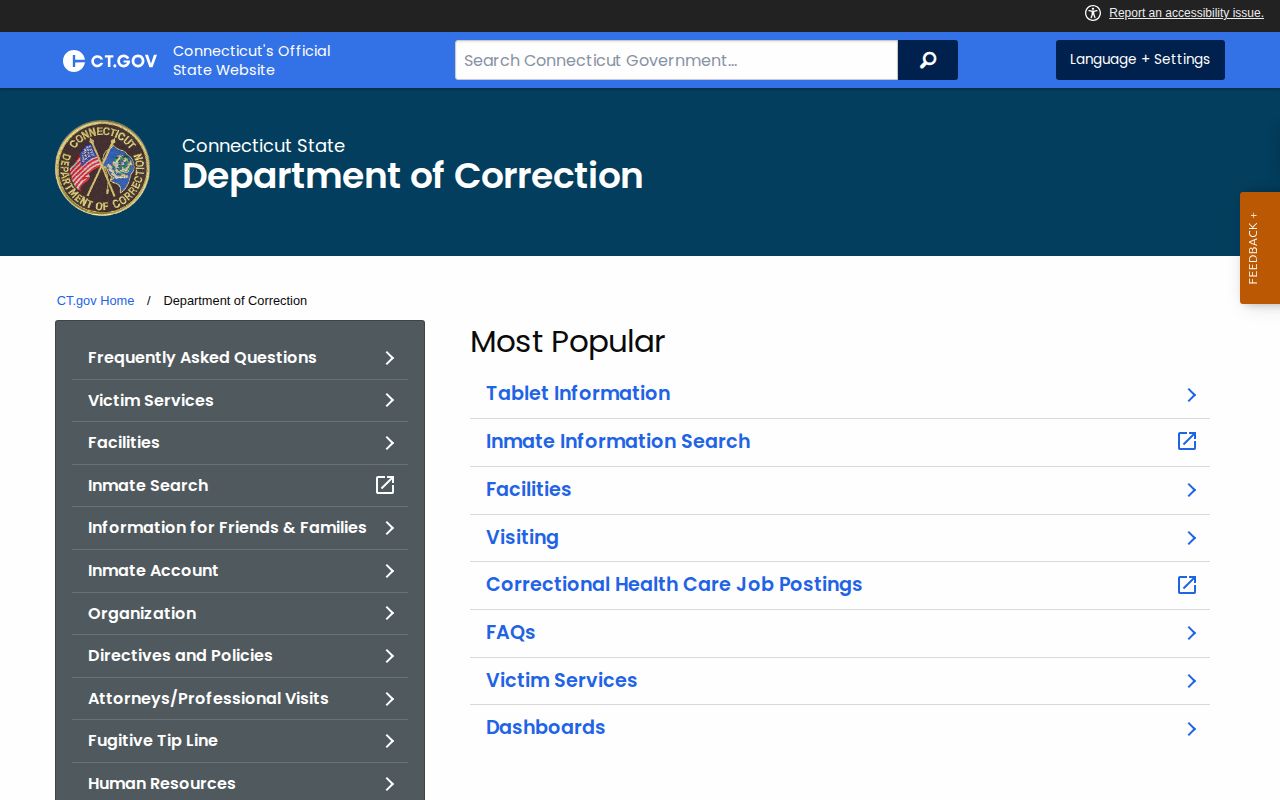
That agency-wide view helps explain why a Connecticut correctional-center release is not handled like a sheriff-run county-jail release in most states.
- Physical release
- Departure from a prison or correctional center, sometimes into continuing DOC supervision.
- Discharge
- The end of CT DOC custody after completion of the governing sentence.
- Detainer
- A hold from another authority that can prevent community release or trigger another transfer.
- Disposition
- The court’s recorded outcome, such as dismissal, conviction, or a sentence that includes probation.
Connecticut Release Records by Type
No one portal covers every Connecticut release. The March 2025 statewide indicators counted 785 releases and discharges, but that total combined end-of-sentence events with parole, special parole, halfway-house placements, transitional supervision, furlough, home confinement, transitional placement, and transfer parole. It included 413 end-of-sentence releases. The categories matter because many people in the total remained under state authority.
| Event | What changed | Best record route |
|---|---|---|
| Bond or court release | Pretrial confinement ends, but the case may continue | Court disposition and maintaining agency record |
| Transfer | Location changes while custody continues | Current CT DOC information |
| Parole or special parole | Community placement with supervision | CT DOC status, BOPP minutes, and VINE |
| Halfway house or transitional supervision | Person leaves a facility but remains under DOC authority | CT DOC current-status channels |
| End-of-sentence discharge | Commissioner’s custody ends | DOC discharged-person records and court disposition |
| Federal release | BOP custody ends or changes | BOP Inmate Locator |
The distinction prevents a common error: treating a move into the community as proof that all custody and supervision ended. It also prevents a transfer between Connecticut facilities from being called a release.
Connecticut Release Record Fields
A focused release record identifies the person, the custody episode, the event that ended or changed custody, and any authority that continued afterward. CT DOC’s published current information can include inmate number, name, date of birth, latest admission date, current location, status, bond amount, controlling offense, sentence date, maximum sentence, maximum release date, estimated release date, special parole date, and detainer. The agency FAQ also identifies minimum release date, correctional history, disciplinary history, and a photograph among information it may provide.
| Field | What it can establish |
|---|---|
| CT DOC number | Agency identifier used to separate people with similar names |
| Latest admission date | Start of the current or most recent documented custody episode |
| Current location and status | Facility confinement, community status, or another present DOC category |
| Maximum or estimated release date | A sentence-computation date, not automatic proof of actual departure |
| Special parole date | A date tied to court-imposed supervision following incarceration |
| Detainer | Notice that another authority may assume custody |
| Discharge or incarceration history | Historical information sought from DOC when the live search is insufficient |
The official DOC FAQ provides the agency’s public-information field context.
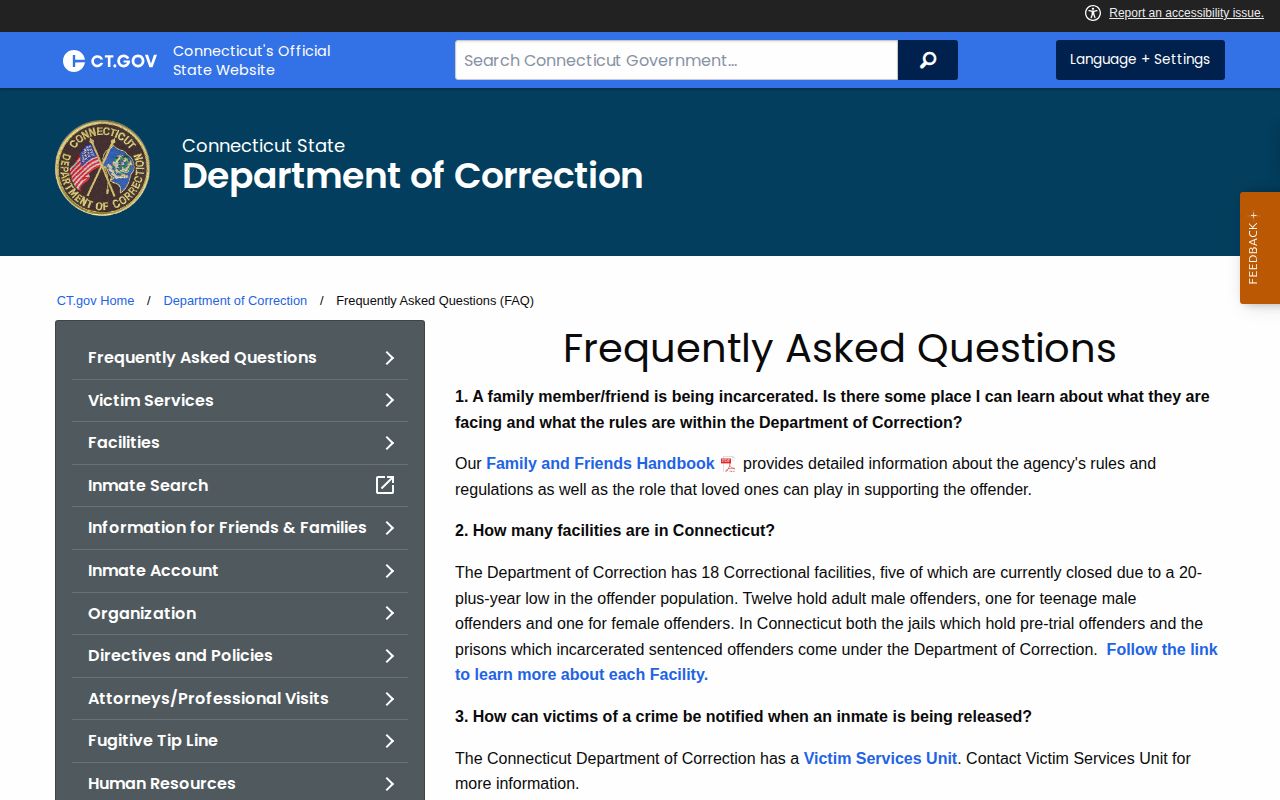
Field names should be read as written. A projected or maximum date is not interchangeable with an actual discharge record.
Request Connecticut Discharge Records
The live offender system is not the final answer for a fully discharged person. Administrative Directive 4.4 says conviction information for people discharged from DOC is released on request, while other information may be available through a Freedom of Information request. A precise request can seek admission and discharge history, sentence-computation records, the recorded release mechanism, or releasable conviction information. It should not demand an undefined “full file,” because exemptions and access limits may apply.
- Check the current CT DOC search to see whether custody or supervision continues.
- Identify the person by full name, CT DOC number if known, and enough facts to avoid a false match.
- State a useful date range and name the existing records sought.
- Submit through the DOC GovQA portal or contact the DOC FOI Office.
- Compare the response with the statewide court disposition when the legal outcome also matters.
The DOC FOI Office coordinates agency requests and reports more than 3,000 documentation requests in an average year.
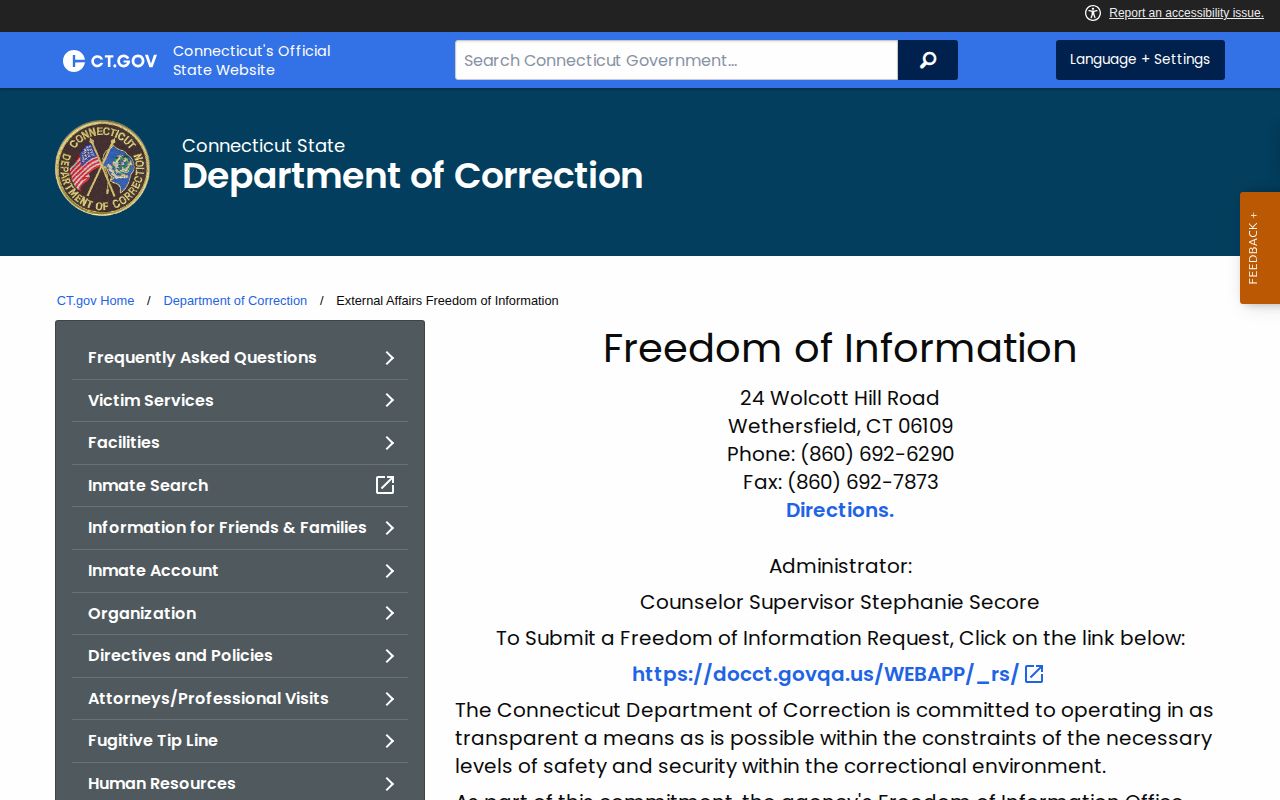
Requests can use the linked GovQA portal. The published office contact is 24 Wolcott Hill Road, Wethersfield, CT 06109, phone 860-692-6290 and fax 860-692-7873.
Connecticut’s FOI Commission says there is no single mandatory request form for all agencies. Send the request to the agency that maintains the record, describe it clearly, and ask for an electronic format when it is reasonably available. Inspection may be requested, though an agency may require a written request for copies.
No statewide flat fee, fixed response deadline, or public post-discharge retention period was confirmed for all Connecticut release records. The safe approach is to ask the maintaining office about copy charges and format before ordering, then keep the request narrow enough for staff to identify the records. “Prompt” access under the FOI Act depends on the request and available records; it should not be translated into an invented number of days. If a response cites an exemption or says no responsive record was found, compare the agency named in the response with the custody path before assuming the event was never recorded.
Note: An absent online result is not proof of release, discharge, transfer, or the end of another authority’s custody.
Connecticut Release Records Law
Connecticut’s Freedom of Information Act appears in Chapter 14. Section 1-210 generally makes nonexempt public-agency records available for prompt inspection and copying. Section 1-211 addresses reasonably producible formats for computer-stored data, and §1-212 governs copies and related access. These rules do not erase limits for protected medical material, juvenile records, security concerns, erased matters, or specified law-enforcement information.
Record boundaries: Chapter 961a can remove erased criminal matters from public view. Youthful-offender, sealed, medical, personal-data, and security restrictions can also limit a DOC response.
Section 1-215 separately defines the public record of arrest while a prosecution is pending and distinguishes it from other records that depict arrest or custody. That distinction matters for booking photographs. Connecticut law should not be summarized as a blanket promise that every custody image is public. The record type, case posture, exemptions, juvenile rules, erasure, and sealing all affect access.
No current official Connecticut statute aimed specifically at private mugshot publishers or pay-to-remove charges was confirmed. Claims assigning that rule to §54-29a are not supported by the official code reviewed for the statewide research. The defensible rule is more exact: ask the police agency for the particular arrest or custody record, apply §§1-210 and 1-215 to that record, and account for Chapter 961a erasure. A denial or missing image should not be treated as proof that no arrest or custody event occurred.
Search Connecticut Released Inmates
The CT DOC Inmate Information Search accepts a CT DOC number, name, and date of birth. DOC says the Offender Based Information System supplies the public portal through a nightly feed for people currently under its custody. That makes it a strong first check for continuing confinement or community authority, not a verified historical list of everyone ever released.
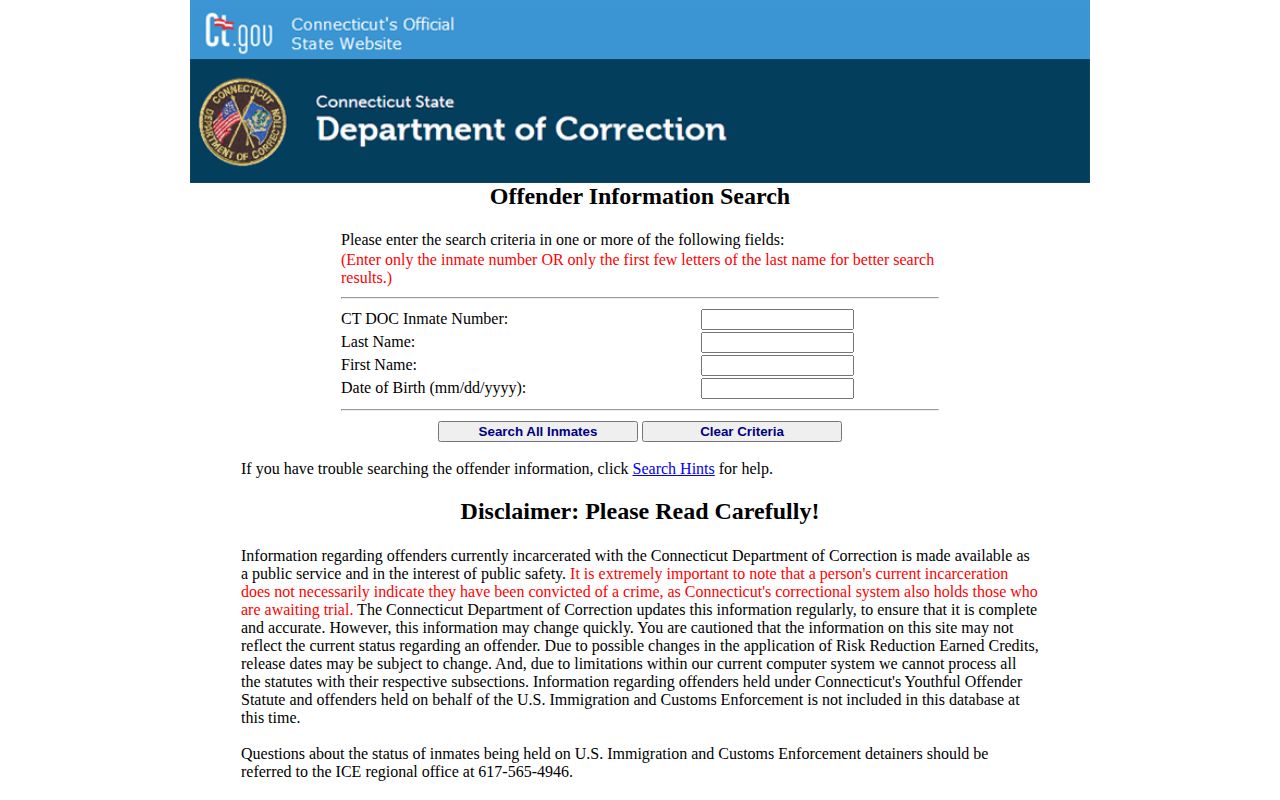
Use the CT DOC number when available. For a name search, add date of birth and compare official identifiers before relying on a match.
- Search CT DOC first when the person entered Connecticut correctional custody.
- Read current location and status before reading any date field.
- If the person is absent or fully discharged, request the DOC record under Directive 4.4.
- Check the Judicial disposition for the case result and any probation sentence.
- Use VINE for alerts, BOP for federal custody, or ICE for current immigration detention.
The DOC information-systems description explains the nightly OBIS feed and its current-custody scope.
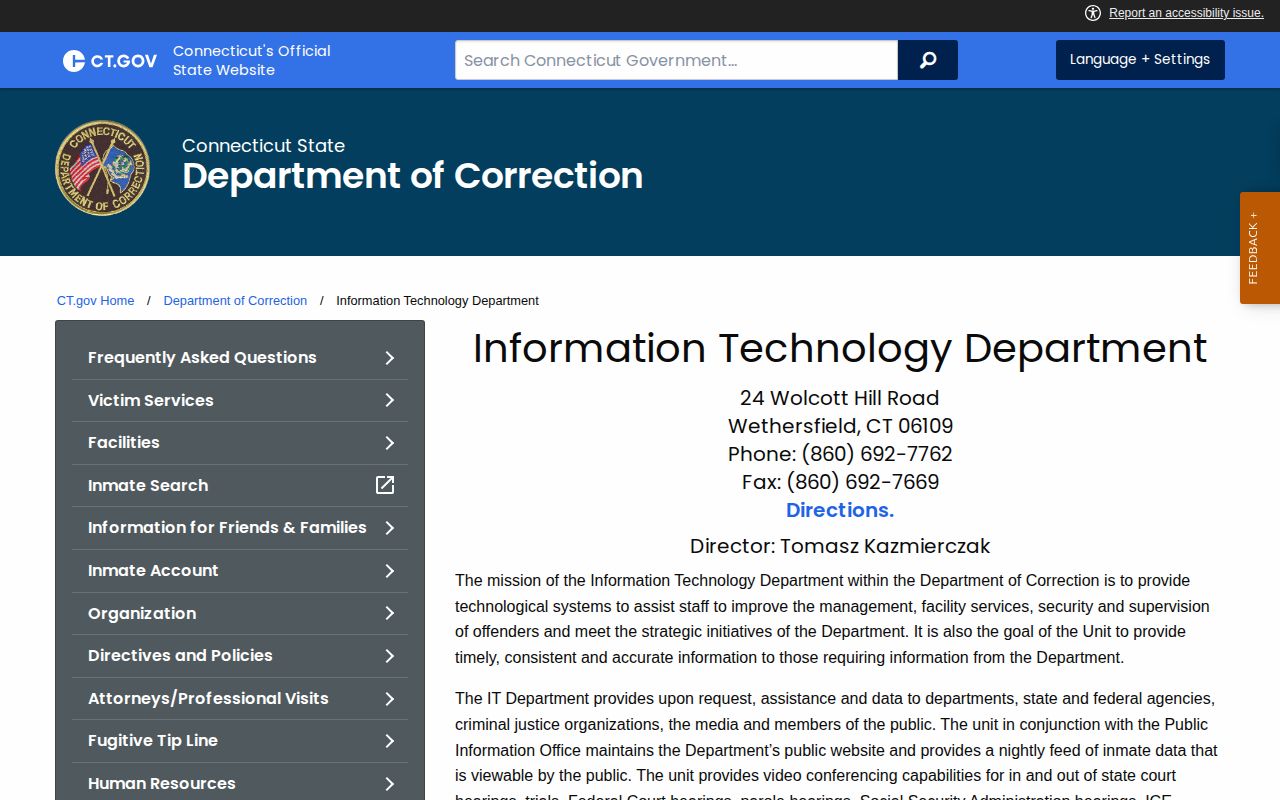
Nightly updates can lag a same-day court order or facility event. The portal also warns that dates can change and not every statute is processed in the computer system.
Important: A person outside a prison may remain under DOC authority, while a missing result can reflect discharge, a spelling mismatch, another system, or protected status.
More detail on the current feed and historical request path appears in the CT DOC offender search resource.
If the record shows a correctional institution or correctional center, confinement likely continues. A community-program location can mean the person is outside a secure facility but still subject to DOC authority. A detainer warns that another authority may take custody even if Connecticut’s sentence permits release. Fully discharged people require the opposite method: use Directive 4.4’s request route rather than assuming the live system keeps a public history. This sequence preserves the difference between a location change, community release, supervision, and the final end of DOC custody.
Connecticut Release Routes Vary
Connecticut’s county-to-county difference is mainly about routing, not separate county jail systems. Municipal police departments keep booking and incident records for their own short holds. Judicial records explain court orders and dispositions. CT DOC correctional centers handle the main statewide jail and intake role. A person who leaves a local police channel may have gone to court or into DOC custody rather than into the community.
The Connecticut Judicial lookup hub routes users to statewide criminal and motor-vehicle case records.
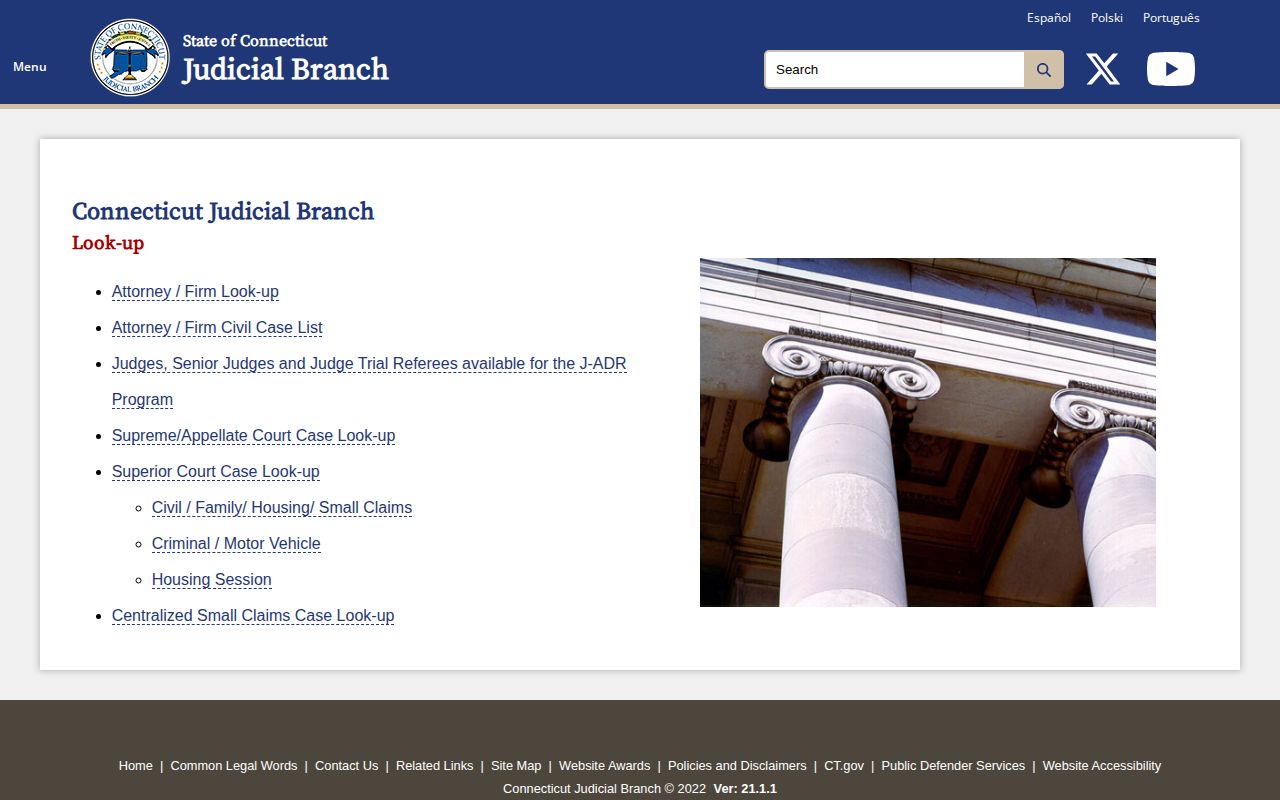
A disposition can explain dismissal, conviction, probation, special parole, or another outcome, but it is not a live custody roster.
Records for a brief municipal hold go to the police agency that made and kept them. Records for state correctional custody go to CT DOC. Court records stay with the Judicial Branch. This agency-by-agency route is more accurate than treating Connecticut’s historic county names as active jail operators.
A court-ordered release deserves one more check. Under Directive 9.3, correctional staff contact facility records when a judge orders release while the person is at court. Another valid sentence or detainer sends the person back to the facility. If none exists, staff ask whether the person wants to return for facility discharge processing. The person may instead be released at court when a return is declined or the judge does not permit it. This explains why some Connecticut releases have no simple facility-gate event and why the court order alone may not prove freedom from every hold.
For a police booking image or incident record, identify the municipality and case date before sending a request. For a Judicial record, use the case number when it is known. For CT DOC, use the inmate number. Those keys keep the search tied to the office and custody episode that produced the record instead of merging separate arrests, sentences, or people with similar names.
Connecticut Release Alerts and Federal Records
CT VINE, formerly SAVIN, offers statewide custody and court-event notifications. Connecticut separates OFFENDERS, which carries DOC information, from OFFENDERS WITH COURT CASES, which carries Judicial information. Register in both when both kinds of notice are needed. VINE is a forward-looking alert channel, not permanent proof that custody or supervision ended.
The VINELink interface provides Connecticut as a search choice.
Short municipal holds are not guaranteed in a published county-by-county coverage matrix, so a no-result must be checked against DOC, police, and court sources.
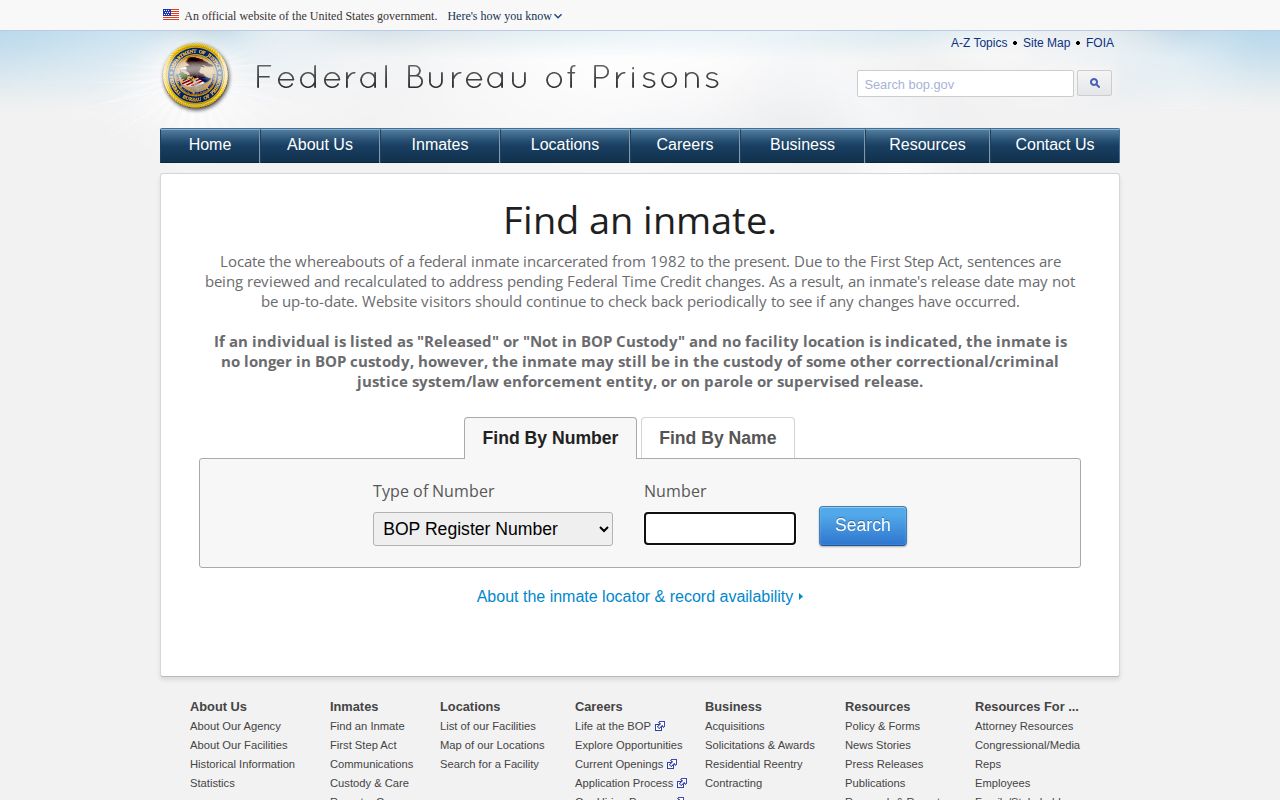
Federal custody requires a different system. The BOP locator covers federal inmates from 1982 forward and can display “Released” or “Not in BOP Custody,” along with a release date. That phrase means BOP custody ended; it does not rule out another system or federal supervised release.
The BOP Inmate Locator supports number and name searches.
ICE’s locator concerns current immigration detention and has no confirmed historical released-detainee archive. A missing ICE result does not prove release or the end of proceedings.
Connecticut Discharge Money Limits
Connecticut gate money is narrow, not a payment promised to every released person. Directive 3.11 calls it discretionary assistance and an earned privilege. Eligibility requires at least 24 continuous months of sentenced incarceration and discharge directly to the community without supervision. The releasing facility ordinarily provides a check, and it is not normally mailed.
The most that may be paid is $50. A person whose relevant savings reached at least $50 receives none; someone below that amount may receive $50. The payment may occur only once in a continuous incarceration term, and discipline or security considerations can make a person ineligible. Parole, transitional supervision, and halfway-house placement do not meet the directive’s direct, unsupervised discharge condition. No universal bus ticket, clothing allotment, or transport benefit was confirmed.
Separately, Directive 10.15 establishes a pre-release identification process covering several forms of identity document. It supports the existence of a preparation process, not a promise that each person leaves with every listed document.
Connecticut Release Counts Need Context
Official Connecticut totals use different definitions and dates. The FY2024–25 DOC digest reported about 3,672 facility releases through Parole and Community Services, including about 2,005 moves to contracted halfway-house programs and 1,667 to approved community residences. It also counted 2,940 people supervised across release statuses on June 30, 2025. These are not 3,672 final discharges.
On August 1, 2026, DOC reported 2,411 people in field services and 10,786 confined. The field-services total included halfway house, special parole, transitional supervision, transfer parole, parole compact, transitional placement, and DUI or home confinement categories. The historical July 1 series used another frame: total supervision fell from 17,805 in 2019 to 12,750 in 2021, then reached 13,609 in 2024. Those series should stay dated rather than be spliced into one trend line.
The DOC monthly statistics page provides the dated reports behind current counts.
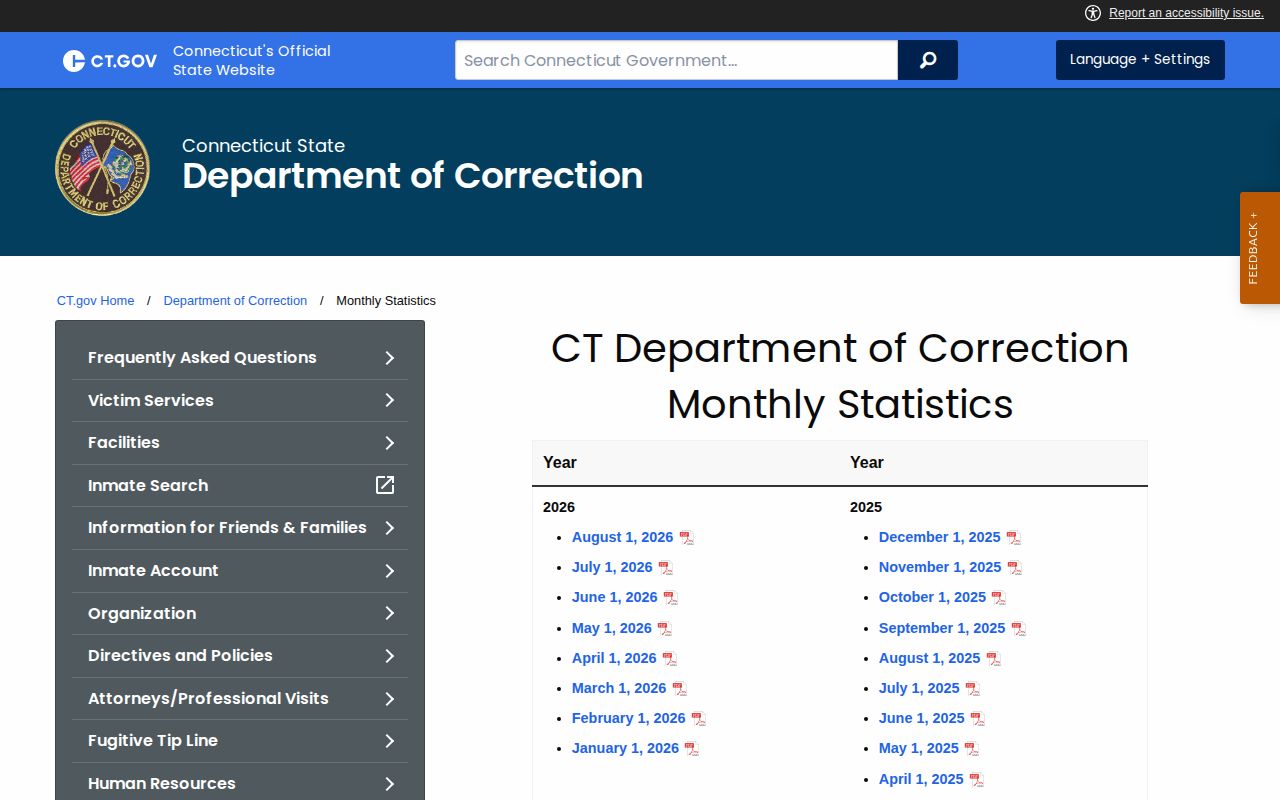
State totals describe categories and populations. They never establish one person’s custody, release, or discharge status.
OPM’s 2025 recidivism brief used still another population: 4,633 sentenced people released or discharged during 2021. It found a 50 percent cumulative return-to-DOC rate within three years, with 17 percent returned by six months and 30 percent by one year. Those are cohort measures of return for any reason. They should not be used to infer that a named person returned, remained free, or held a particular supervision status.
Connecticut Release Source Comparison
Choose the system that created the event. A current correctional result, a court outcome, an agency response, and a notification serve different purposes, so agreement across sources is stronger than one unexplained portal result.
| Source | Best use | Main limit |
|---|---|---|
| CT DOC search | Current confinement or continuing DOC authority | Not a confirmed full-discharge archive |
| DOC FOI record | Historical discharge, conviction, or sentence-computation records | Exemptions and erasure may limit release |
| Judicial lookup | Case disposition and sentence context | Not a live custody system |
| CT VINE | Custody and case-event notifications | Not permanent proof of discharge |
| BOP locator | Federal custody and released result | Does not resolve state or immigration custody |
| ICE locator | Current immigration detention | No confirmed historical release archive |
Facility names and locality routes are collected in the statewide navigation, while the record itself should come from the office that created or maintains it.